Nobody Called You a Caregiver. But That's What You Are.
Most caregivers don't recognize themselves by that name until they read this. If you're managing someone else's health, medications, or safety, this is for you. Family Caregiver Identity
Lindy Ann
7/20/20263 min read
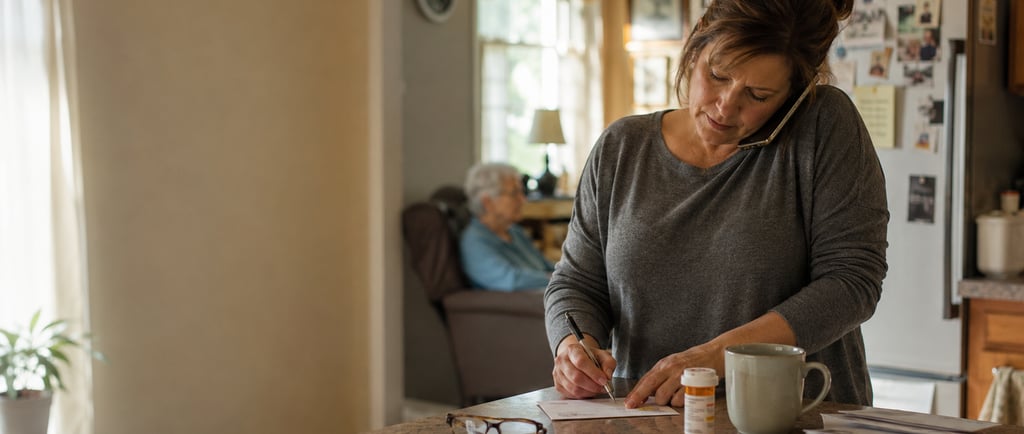
There was no ceremony.
No title given. No onboarding. No one pulled you aside and said: starting today, you are a caregiver — here is what that means, here is what it will cost you, and here is how to do it without losing yourself in the process.
It probably started with something small. A ride to the doctor. A phone call that lasted longer than usual. A moment when you looked across the table and understood — without anyone saying it — that the person you love needed more than they would ever ask for.
And so you did what you do. You showed up.
That was the moment you became a caregiver. You just didn't have a word for it yet.
The Numbers That Will Make You Feel Less Alone
Here is something that might change the way you see yourself:
Right now, there are 63 million Americans doing exactly what you are doing. Not approximately. Not roughly. Sixty-three million people tracking medications, coordinating appointments, managing fear, absorbing grief, and still showing up the next day. That number jumped from 43.5 million in 2015. In ten years, the caregiving population grew by nearly 45 percent.
You are not a rare case. You are not an outlier. You are part of the fastest-growing invisible workforce in America — and almost none of you chose the title.
Nearly 1 in 4 adults is a family caregiver right now. If you look around a room of twelve people, three of them are carrying what you are carrying. They are just as quiet about it as you are.
The reason most people don't recognize themselves in that word — caregiver — is that our culture built a very narrow picture of what it looks like. An older woman in a nursing facility. A professional with a badge. Someone doing this full time, on purpose, with training.
But the 2025 AARP report on caregiving in America found something different. Today's caregivers are increasingly younger, more diverse, more likely to be working full time while doing this, and more likely to be caring for more than one person at once. Nearly 1 in 3 is also raising children. Almost half of caregivers under 50 are doing both — simultaneously caring for their kids and for an aging parent or family member.
That is not a caregiving role. That is an entire second life layered on top of the first one.
The Moment You Recognize Yourself
I want to ask you something, and I want you to sit with it honestly.
Have you ever stood in a pharmacy line and felt your heart rate change because you couldn't remember if the prescription had been filled? Have you ever woken up at 2am and run through a mental checklist of things that needed to happen that day? Have you ever caught yourself describing someone else's medical history so fluently that it surprised you?
Have you ever felt guilty for not doing enough, and simultaneously exhausted by how much you are already doing?
If any of those landed somewhere specific in your chest — that is recognition. That is your mind identifying an experience it has been living without a name for.
You are a caregiver. And the moment you claim that word, something shifts — because suddenly you are not just a person drowning in tasks. You are someone in a role, and roles have support systems, communities, tools, and resources that exist specifically for you.
What Recognizing It Changes
Research has found something consistent and important: caregivers who identify themselves as caregivers are significantly more likely to seek support, access resources, and connect with others in similar situations. The ones who don't name it tend to white-knuckle through alone — which, as anyone who has done that knows, has a ceiling.
The name is not a label that limits you. It is a door that opens things.
It means you are allowed to ask for help. It means the exhaustion you feel is not a character flaw — it is a documented, studied, statistically predictable response to an enormous amount of invisible labor. It means the grief you feel, even while the person you love is still here, is real and has a name too (it's called anticipatory grief, and it is common and valid).
It means you are not alone in this, even when it feels most like you are.
What Health & Haven Is Here For
I built Health & Haven because I was once the person standing in that pharmacy line with my heart going too fast, trying to hold too much in my head, with no system and no community and no one who really understood what my days felt like.
I am not a medical professional. I am someone who lived this and who spent a lot of time thinking about what would have helped most if someone had handed it to me early.
This blog exists to be that. Real tools. Honest conversation. No clinical distance, no empty encouragement. Just practical support from someone who has been in the same kitchen, at the same 2am, asking the same questions.
You found this for a reason. Welcome.
With care, Lindy Ann Founder, Health & Haven
Written by Lindy Ann, B.S. Health Science, caregiver and founder of Health & Haven. These resources were developed while coordinating medications and care for a family member